


August 12, 2026
You've told the story a hundred times. To your therapist, your best friend, or maybe even a journal when your body wouldn't let you sleep. You can recite the timeline of the betrayal in perfect detail: what you found, when you found it, what was said after. You understand it now. Intellectually, you get it.
So why does your chest still tighten when your partner's phone buzzes? Why do you still scan their face for signs of a lie, even months after the "healing" conversations are supposed to be done?
This is the part nobody warns you about. Talk therapy can help you make sense of betrayal. But making sense of something and feeling safe in your own body again are two different jobs, and they need two different kinds of help.
"Betrayal trauma," a term coined by psychologist Jennifer Freyd, describes what happens when the harm comes from someone you depend on for safety, a partner, a parent, someone whose whole job in your life was to be trustworthy. That's what makes it different from an ordinary disappointment. Your nervous system doesn't just register a hurt feeling. It registers a broken alarm system.
Research on betrayed partners backs this up. Studies on infidelity survivors have found that somewhere between 30 and 60 percent experience PTSD-level symptoms: intrusive thoughts, hypervigilance, emotional numbing, and physical distress that shows up in the body long after the initial conversation is over.
That's the piece talk therapy alone often misses. You can process the story in words and still flinch every time your partner is five minutes late. You can forgive, or decide to stay, or decide to leave, and your shoulders will still live up around your ears. The insight arrived. The body didn't get the memo.
This isn't a knock on talk therapy. It's genuinely useful, and for a lot of what betrayal brings up, it's exactly the right tool.
Talk therapy helps you:
If your mind is the part that needs organizing, talk therapy does that job well. The trouble is that trauma, especially the relational kind, doesn't only live in the thinking part of your brain. It lives in your gut, your jaw, your shoulders, the place behind your eyes that tightens when you're bracing for bad news.
Somatic therapy works from a different starting point. Instead of asking "What happened and what does it mean?" it asks, "What is happening in your body right now, and what does it need?"
Bessel van der Kolk's research on trauma, widely cited in the field, points to something clinicians see constantly in practice: trauma changes how the body processes danger, often independent of what the thinking mind believes to be true. That's why you can know, logically, that you're safe and still feel like you're not.
A somatic approach, including a method called Somatic Experiencing, works with the physical sensations connected to fear, distrust, and hypervigilance directly. Instead of only talking about the panic that hits when your partner is late, a somatic session might have you notice where that panic lives, in your chest, your throat, or your stomach, and slowly work with your nervous system until it learns that alarm doesn't have to fire every time.
If you're picturing something strange or clinical, it's usually much simpler than that. Somatic healing in NYC sessions might include:
Nothing about this replaces your ability to think and talk it through. It works alongside that, so the insight you gain in your mind actually reaches your body too.
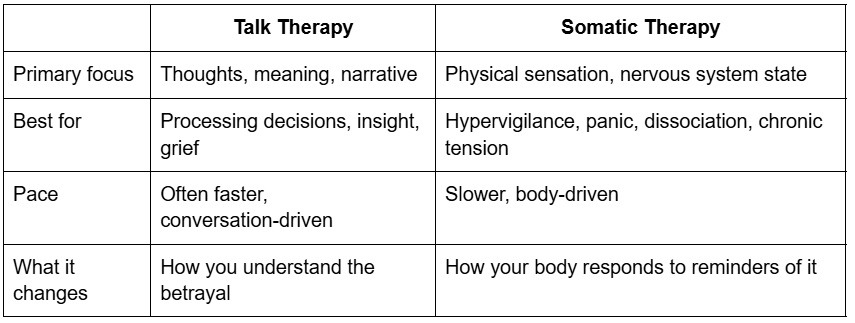
Most people healing from betrayal need both. That's why a lot of trauma-informed practices in the city blend the two rather than picking one.
Betrayal is a particular kind of injury because it comes from your attachment system, the same wiring that, as an infant, told you who was safe to depend on. When that system gets a signal that your safe person is actually the danger, your body doesn't file that away neatly. It goes on alert. Sleep gets harder. Your stomach might be in knots for weeks. You might notice you're holding your breath without realizing it.
Talking about the affair or the deception can help you understand it. It rarely, on its own, teaches your body that it's allowed to exhale again.
If you're in New York and trying to figure out where to start, look for a therapist trained specifically in body-based, trauma-informed work, not just someone who mentions it in passing. Somatic healing in NYC is often most effective when it's paired with relational therapy, so you have support both for the story and for your nervous system's response to it. A good first session should feel collaborative. You should never feel pushed to relive the betrayal in detail before your body is ready for that.
Stephen Porges' Polyvagal Theory, one of the more influential frameworks in trauma treatment over the past two decades, describes how your nervous system is constantly scanning for cues of safety and danger below the level of conscious thought, a process he calls neuroception. That scanning doesn't stop just because you've had a good conversation about what happened. It shifts slowly, through repeated experiences of actual safety, which is exactly the terrain somatic work is built for.
A few questions worth sitting with:
If any of that sounds familiar, a combined approach, talk therapy for the story and somatic work for the nervous system, is likely to get you further than either one alone.
Is somatic therapy just talk therapy with breathing exercises added on?
No. Somatic therapy works directly with physical sensation and nervous system regulation as the primary focus, not as an add-on. A trained somatic therapist tracks what's happening in your body throughout the session, not just what you're saying.
How long does it take to feel a difference with somatic therapy after betrayal trauma?
It varies by person and history, but many clients notice small shifts and less reactivity and better sleep within the first several weeks of consistent sessions. Deeper nervous system change tends to build gradually through repeated experiences of safety.
Can I do somatic therapy alongside couples counseling?
Yes, and for a lot of people it's the most effective combination. Somatic work for your individual nervous system alongside couples work for rebuilding trust in the relationship addresses both layers of the injury.
Do I need a diagnosis of PTSD to benefit from somatic healing in NYC?
No. You don't need a formal diagnosis to benefit from body-based therapy. If betrayal has left you hypervigilant, numb, or physically tense, that's reason enough to explore this kind of support.
Understanding what happened is a real and necessary part of healing from betrayal. But if your body is still bracing for impact months after the conversations have ended, insight alone probably isn't the missing piece. Your nervous system needs its own path back to safety, and that's work talk alone can't finish.
If you're ready for support that includes both your mind and your body, the therapists at CAP therapy integrate somatic therapy with relational, trauma-informed care built for exactly this kind of healing. Book a free consultation and take the next step toward feeling safe in your own body again.